
anOrdain’s Model 1 Porcelain goes on sale on 27 August. Seventy pieces, £2,200 plus VAT, and a dial made by one person in Glasgow who bins roughly 260 of them a month. Here’s why that’s the most honest thing in watchmaking right now.

Mass production. That’s a phrase we cannot escape in the 21st century. Ever since it was coined in 1926 by Encyclopaedia Britannica for the work of the Ford Motor Company, it has been the very thing that mainstream capitalism has been built around.
From the Ford Model T, to the iPhone, to the Casio.
Mass production has largely focused on mainstream consumer goods, which has driven down prices, with companies able to pursue profits through volume and easily applicable optional upgrades at massive margins.
What mass production has never really been is luxurious, though.
And yet.
Rolex make over 1 million watches a year. Cartier just shy of 700,000. AP, 50,000.
The greatest names in luxury watches are a lot more common and a lot more mass produced than many of us think.
So today, I’m making an argument against this contemporary understanding of luxury, and instead making a case for something a little different.
The news

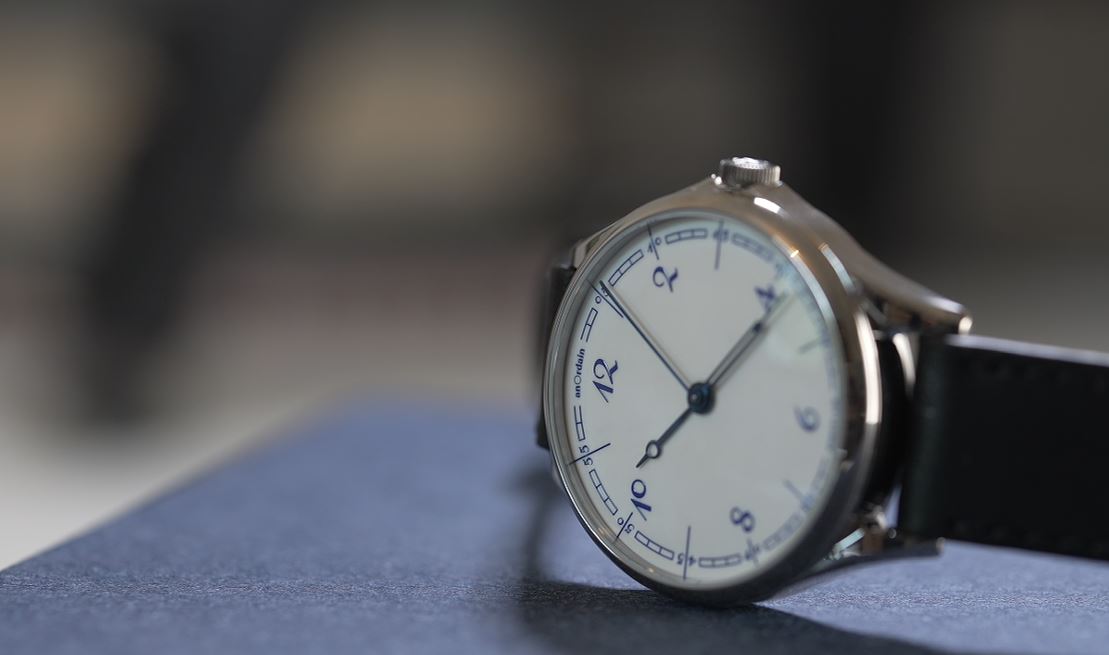
This is the newly released anOrdain Model 1 Porcelain, on loan from the team up in Glasgow. This is what a luxury watch should look like, in my opinion.
It goes on sale on 27 August through anOrdain’s own website. Seventy pieces at launch, then small batches added monthly, shipping within a fortnight of purchase. The standard version runs a La Joux-Perret G101 at £2,200 plus VAT, or $2,950. The decorated A1 version of the same movement, which is the one I’ve been wearing, is £2,520 plus VAT, or $3,400. Existing customers get 24 hours of early access before the general release.
And critically, you can buy it without joining the enamel waiting list, which currently runs to something like five years.
Hold onto that last detail, because it turns out to be the whole story.
Not because it’s a dress watch, not because it mimics a Patek Philippe Calatrava, or because it even is just expensive, but because it is a representation of what true craft looks like.
There’s a second argument in here too, and it’s one I didn’t expect to be making in a piece about a watch. Scarcity used to mean rare materials. I think it’s starting to mean something closer to human contact. I’ll come back to that.
Time is money

Time is money.
That is a phrase that spreads far and wide within society, from business to your budgeting.
And when you are buying something, you are buying time from someone. So a watch and its materials, yes, but also the time to produce that watch, design that watch, brand and market that watch.
Time underpins everything.
This is one of the reasons why mass production drives down prices. In the time where you could make one thing by hand, you can make 100 of the same object.
anOrdain as a brand stands against this. The Scottish microbrand is largely known for their enamel dials, which do take a lot of time, see a lot of these dials fail, and mean the actual number of watches the company can produce is minimal.
Paulin are anOrdain’s volume brand, with the same sort of well designed idea underpinning everything, but with the idea that every now and then you find a way to cut a corner to speed things up, such as with outsourced dial production.
anOrdain keep that sort of stuff in house.
Which left them with a problem. Enamel is so slow that the waiting list stretched out to five years. Most businesses solve that by finding somewhere to compromise. You outsource the dial. You buy the component in. You accept that the customer will never know the difference.
anOrdain went the other way. They went looking for a second craft that was almost as difficult as the first one.
The dial nobody else is making

To keep up with demand, back in 2022 anOrdain started developing their porcelain collection, this particular one designed by Kia Tasbihgou.
And the word porcelain needs pinning down here, because the industry has been sloppy with it for years. When a watch brand says “ceramic dial” or “porcelain dial”, what they almost always mean is a sheet of pre-manufactured zirconia ceramic. An industrial material. Bought in, cut, printed, fitted.
This is not that. This is clay, drawing on traditional pottery technique, fired in Glasgow using processes the company developed itself. Same word on the dial, completely different object underneath it.
Note the blue typography matching the blue hands, contrasting against the white dial.
The numerals are Breguet-esque, but look at how the nought sits next to the one at the 10 hour marker. It’s playful. It’s modern.
And the combination of blue and white is like traditional porcelain, a craft most known for its blue and white ceramic look.
That reference is deliberate, though not in the way you’d assume. Tasbihgou is a typographer whose work runs from Frank Ocean to Vanity Fair. He isn’t a watch person, and anOrdain hired him precisely because he isn’t a watch person. Lewis Heath, who founded the company, has said the brief was left deliberately wide open, on the grounds that Kia hadn’t arrived with a head full of watch dials.
What did shape it was a conversation about Breguet pocket watches, and Heath’s memory of blue print on white porcelain at Rem Koolhaas’ Casa da Música in Porto, set against all that undulating floor to ceiling glazing. Which is an unusual thing to find in a watch press release, and it tells you roughly everything about what kind of company this is.
Look closely at the hour hand. The off centre hole in it echoes the shape of the zero in the numerals, while the minute hand is angular where the hour hand is round. The hands and the type were drawn as one composition, rather than ordered separately from a catalogue and hoped for the best.
But that’s not why this is luxurious.
The number

Here’s why.
One person makes these dials. Not seven. One. A single ceramic specialist, working in Glasgow.
That person produces around 300 porcelain dials every month. Thirty to 40 of them make it into a watch. The rejection rate runs as high as 90%, because clay does what clay does, and most of them come out of the kiln imperfect.
That means to make this watch, anOrdain waste time. Time is money, and thus anOrdain waste money.
260 dials a month, made properly, by hand, and then binned.
Do Rolex waste money on porcelain dials? No. They’re too finely tuned financially, having achieved complete vertical integration. Ultimately, other than image, from a production standpoint very little actually separates Rolex from Seiko.
You’ll get a wasted bezel here or there, like on the GMT-Master II Pepsi, or an enamel dial on the vastly overpriced rolex Daytona.
But across the entire brand? Failure rates are low. Consistency and reliability is what their image of luxury was built upon. But it’s a distortion of what luxury is, and it’s bad for us.
To wear this anOrdain, with its high failure rate, is to wear a watch that says I am spending money on bits of a watch that ended up on the floor. Not something you materially got as part of the watch.
This watch says you support throwing money away. A bit of a flex, yes. But the more true reality for us watch nerds is that you support something suboptimal, something prone to imperfection, and most importantly, ultimately human.
The obvious objection

The obvious response to all of this is that I’ve just spent a thousand words describing bad manufacturing and calling it a virtue. It’s a fair hit. A 90% failure rate is, by any normal industrial measure, a process that isn’t working. If your local garage told you nine out of ten of the parts they made had to be scrapped, you wouldn’t call them artisans.
So let me be clear about where the line sits. I’m not arguing that failure is the point. Nobody in Glasgow is celebrating the bin. I’m arguing that the failure rate is evidence of something that can’t be faked, which is that the object in front of you was made by a person doing a difficult thing, badly enough of the time to prove it was difficult.
There is a version of this that’s genuinely just incompetence dressed up in nice photography, and the microbrand world has no shortage of it. The test is whether the difficulty is buying you something. Here, it is. The dial has a depth and a faint unevenness that a zirconia sheet can’t give you, because a zirconia sheet has never been near a kiln that could ruin it.
And there’s a second bit of evidence that the difficulty is deliberate rather than accidental. The strap.
anOrdain’s bespoke leatherworker, can spend up to three days on a single strap. The company’s own press release describes that as “hopeless for volume”, which is a rather lovely thing for a business to admit in writing. So last year they set up a textile department to try hand making straps in small batches, and this watch is the first to ship with them as standard. It’s a trial run, with the stated aim that eventually every anOrdain comes with one.
A company optimising for margin does not build a leather department. It phones Vietnam.
What luxury stopped being

The modern luxury industry, and not just watches, we’re talking luxury car brands like BMW, Porsche, even Ferrari, we’re talking clothing brands like Loro Piana, Ralph Lauren and Gucci, have decentred the intelligent engineer, the visionary designer, the skilled seamstress even, in favour of a movement to mass production backed by image and reputation upheld by global marketing agencies.
If we think about this in watches, the method of doing business in the luxury watch world is very much like it is in German cars or fashion houses.
You have the overpriced base option, then the two tone version for 40% more, the solid gold one for 300% more.
Want a more interesting dial colour than white or black? Well, it’ll cost you.
A rubber strap with your Seamaster? We’ll use it as a deal sweetener if you buy it today. But only if you buy it today.
It’s insidious, and it’s how all big business works.
This, most importantly, is not the watch industry we were sold in the 1970s, 1980s and 1990s, as brands pivoted into their luxury stance.
We were sold a romantic vision of établissage, where different components are made by different little craftsmen all across the Swiss countryside.
Instead it’s far different. It’s companies owning shares in their suppliers, it’s outsourcing to China, it’s mark ups, it’s manipulation.
Rolex, Cartier, AP, they’ve got excellent products. But if you strip away the marketing, they are just that, and you and I will avidly consume just that. I do believe it is time for a change.
The second kind of luxury

So that’s the argument about production. Here’s the one I actually came round to while I was wearing this.
In 2026 we have another idea of luxury emerging.
Our connections to our fellow man.
Society is more connected than ever before at a global level, but as a consequence of this we’ve had the decline of third spaces and the decimation of our local communities.
In social media commentary discourse last year, privacy started being discussed as the new luxury. To live a life quietly outside of the public eye, in the age of Instagram stories and 5G towers, was the new luxury.
Having no social media, private accounts, minimal followers, was a signifier that you were free from society. Self sufficient, not only with a strong sense of internal validation, but also by not being yet another content creator looking to make it big and quit their job for a life of flexibility.
Happy to be isolated, with a small community. A small circle.
In this age where community, where intimacy, seems like a premium, the mass produced rolex appears to draw you away from people.
While you may argue that a rolex brings you closer to other rolex owners, I’d counter that by asking how many of those are now your close friends.
Wearing a Submariner, a Tank Must, a Seamaster, is to wear a piece of machine made toolery. It hasn’t required the labour, the toil, the sacrifice of a dedicated artisan up in Scotland.
That labour is what appeared to make luxury Swiss watches luxurious for many in the first place. But for the most part you don’t get it anymore.
Then we come to anOrdain. Well, it needs the frustratingly difficult work, the craft.
This watch not only tells the time, but it carries it too, which is something incredibly intimate and I believe is incredibly luxurious.
Verdict
So if you’re feeling a little rebellious, I’d implore you to go a little deeper into the world of brands like anOrdain, because for what is longines money you are getting what I’d be willing to suggest is actual luxury. A piece where the branding is minimal, and the flex of the name won’t sway anyone into thinking you’re generationally wealthy.
But what it will do is force you to remember that the very best things in life often take the most work. And very occasionally, it’s worth it to push something to its absolute limit.
Seventy of these go on sale on 27 August. 260 dials a month end up in the bin so that they can. That’s the most honest price tag in watchmaking right now.
What other brands are doing work like this, at a price point you and I can actually consider? The comments are open.
anOrdain Model 1 Porcelain Specifications
| Case diameter | 38mm |
| Lug to lug | 46mm |
| Case depth | 11mm |
| Case finish | Brushed / polished 316L steel |
| Strap width | 18mm |
| Dial | White glazed porcelain |
| Movement | La Joux-Perret G101, or A1 (decorated G101) |
| Glass | Sapphire with three layers of anti-reflective coating |
| Hands | Thermally treated steel |
| Caseback | Screw-in |
| Water resistance | 5ATM |
| Warranty | Five years |
| Price | £2,200 + VAT / $2,950 (G101), £2,520 + VAT / $3,400 (A1) |
| Availability | 27 August, anordain.com. 70 pieces at launch, monthly batches thereafter |

Leave a Reply