
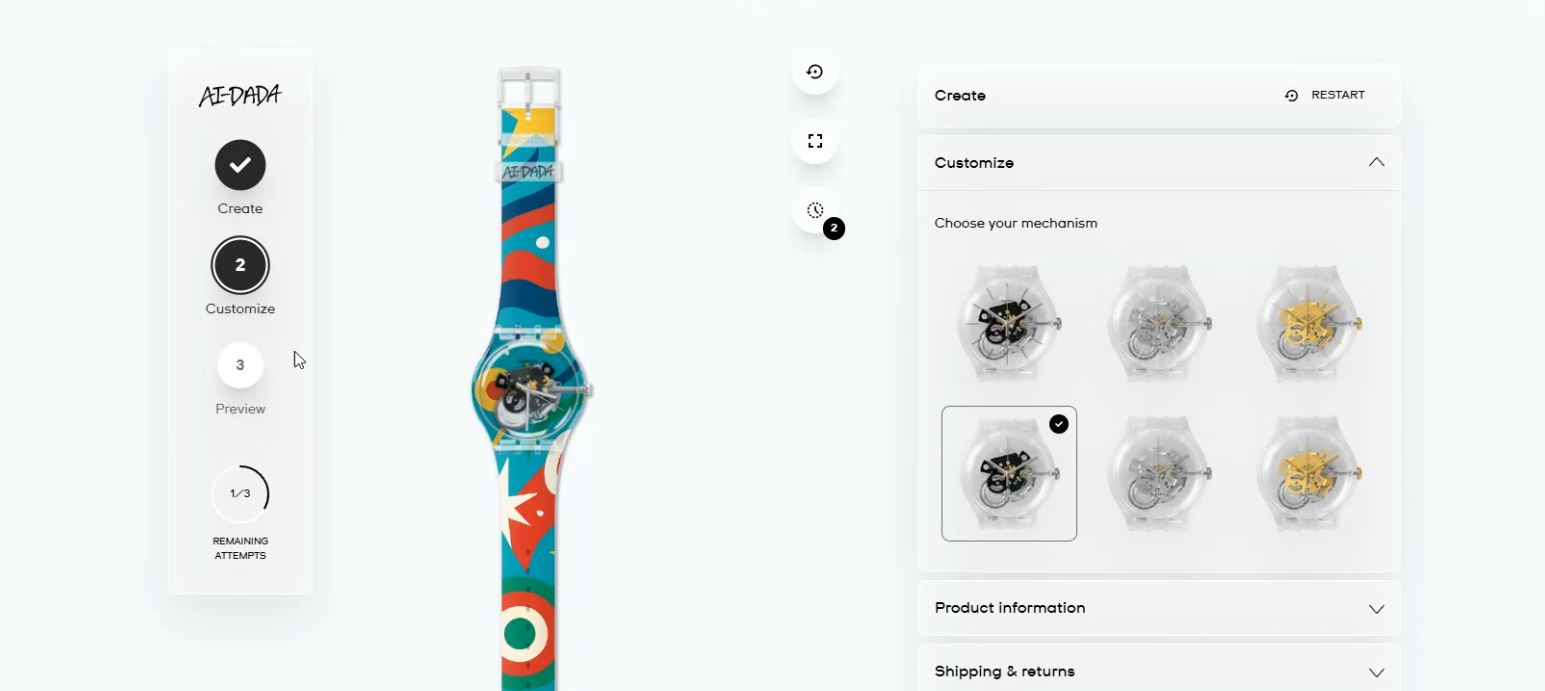
Swatch may have just done something far more significant than launching another playful collection. With the release of its AI-powered design tool, AI-DADA, the brand has opened a door that could fundamentally reshape how watches are imagined, created, and produced, for better or worse.
Let’s unpack what’s really going on.
A Quiet Revolution in a Traditional Industry
For years, artificial intelligence has dominated headlines across industries, from finance to film, yet its impact on watchmaking has seemed minimal. Beneath the surface, however, major manufacturers have undoubtedly been exploring how AI could streamline prototyping, marketing, and even design itself.
Now, Swatch has made that exploration public.
AI-DADA, their new “Dream it. Prompt it. Wear it.” tool, allows anyone to generate a custom watch design using simple text prompts. Users type in an idea, the system produces a design based on Swatch’s historical archive, and for around 170 Swiss francs, that design can be turned into a physical watch.
At first glance, it feels innovative, democratic, even fun. But beneath that surface lies something more disruptive.
Why “AI-DADA”?
The name itself is telling. It references the Dada art movement, which emerged after World War I as a rejection of traditional aesthetics. Dada artists embraced chaos, randomness, and anti-structure, often producing work that felt intentionally nonsensical.
That comparison may be more accurate than Swatch intended.
Using the tool reveals a familiar pattern. Sometimes the results are intriguing, occasionally even compelling, but often they are incoherent, derivative, or simply average. Like many generative AI systems, the output depends heavily on the prompt and the data it was trained on.
How the Technology Works
AI-DADA is essentially a specialized AI agent trained exclusively on Swatch’s own archives, over 40 years of designs, artworks, and brand collaborations. It operates within a closed system, meaning it does not pull from the wider internet but instead recombines internal visual data to generate new designs.
Technically, it leverages tools like Microsoft Azure and OpenAI-powered models to synthesize these outputs. In simple terms, it does not invent in the human sense. It remixes.
This distinction matters.
Because what AI-DADA produces is not truly new. It is a variation on what already exists.
The Illusion of Creativity
In testing the tool, patterns quickly emerge:
- Broad prompts produce chaotic, often messy designs
- Specific prompts, especially those referencing past Swatch styles or collaborations, yield more coherent results
- Attempts to push beyond Swatch’s design language, for example vintage dive watches, fall flat
- Certain references, like specific competing brands, are blocked entirely
This reinforces a key limitation. AI is only as creative as its dataset. It cannot step outside the boundaries of what it has already seen.
The Ownership Question
There is another layer to this story, one that raises more concern.
Swatch’s terms of service make it clear that:
- The company owns the rights to the generated designs
- User prompts and outputs are stored
- Users have no claim to the resulting creations
On its own, this is not unusual. But in the context of AI development, it becomes more significant.
Every interaction with the tool can be used to refine and improve the system through reinforcement learning. In effect, users are helping train Swatch’s design engine, free of charge.
A Tool or a Test Case?
Swatch insists that AI-DADA is “a Swatch tool” and not intended for broader internal application. But the implications are hard to ignore.
If a brand can:
- Train a model on its design history
- Collect user-generated prompts and preferences
- Rapidly generate new variations
Then it can dramatically accelerate product development.
And potentially reduce reliance on human designers.
What Happens to Watch Design?
This is where the real tension lies.
The watch industry has already faced criticism for becoming predictable and homogeneous. AI, at least in its current form, risks amplifying that problem rather than solving it. It excels at producing safe, familiar, average outputs, precisely what many enthusiasts feel the industry already has too much of.
More importantly, true innovation in watchmaking has always come from individuals:
- Visionary designers
- Independent watchmakers
- Creative risk-takers
Remove or diminish that human element, and you risk losing the breakthroughs that define the craft.
There would be no radical new case designs, no mechanical innovations, no unexpected artistic directions, just increasingly refined variations of the past.
The Bigger Picture
Swatch is not alone. If this technology proves viable, it is reasonable to assume other major groups will follow, whether openly or behind closed doors.
AI promises efficiency, and in corporate language, efficiency often means fewer people.
That could push genuine craftsmanship further into the realm of ultra-luxury, leaving mass-market watch design increasingly automated, iterative, and safe.
So, Did Swatch End Watch Design?
Not yet.
But AI-DADA represents a turning point.
It shows that the tools now exist to automate aspects of design that were once deeply human. Whether those tools enhance creativity or erode it will depend on how they are used, and how much value the industry continues to place on the people behind the work.
Because at its core, watchmaking has never just been about assembling parts or generating patterns.
It has always been about ideas.
And that is something no algorithm has truly mastered, at least not yet.

Leave a Reply