
Dive watches, if we’re being honest, are often more about identity than necessity. The category was arguably perfected long ago by icons like the Rolex Submariner, the Omega Seamaster 300, and the TAG Heuer Aquaracer. Between them, they established the blueprint for what most people still think of as the modern dive watch.
And yet, despite that maturity, new entrants keep arriving. The latest is the Nomadic BRU 750 from Belfast-based microbrand Nomadic Watches, a 750 metre-rated titanium dive watch that positions itself not as a reinvention of the genre, but as a specification-led alternative to Swiss luxury divers.
At £1,950, it sits in an interesting bracket: not entry-level, not fully luxury either. It competes directly with watches like the Longines HydroConquest and Oris Aquis, established Swiss divers where brand heritage, finishing, and story matter just as much as technical ability.
Specification First: Titanium, Ceramic, and 750 Metres
On paper, the BRU 750 is impressive, arguably overbuilt for most real-world use.
Key highlights include:
- Grade 5 titanium case and bracelet (with stainless steel clasp)
- 750m water resistance
- Ceramic bezel insert
- Flat sapphire crystal
- Super-LumiNova
- Helium escape valve
- Sellita SW200-1 automatic movement
That last point is important. Inside is the widely used Sellita SW200-1, a workhorse movement often positioned as a Swiss alternative to the ETA 2824 family, a calibre lineage seen across everything from entry luxury to mid-tier Swiss brands.
It offers around 41 hours of power reserve and sits firmly in the “proven and dependable” category rather than anything technically exotic.
Design: Subtle Green, Strong Presence
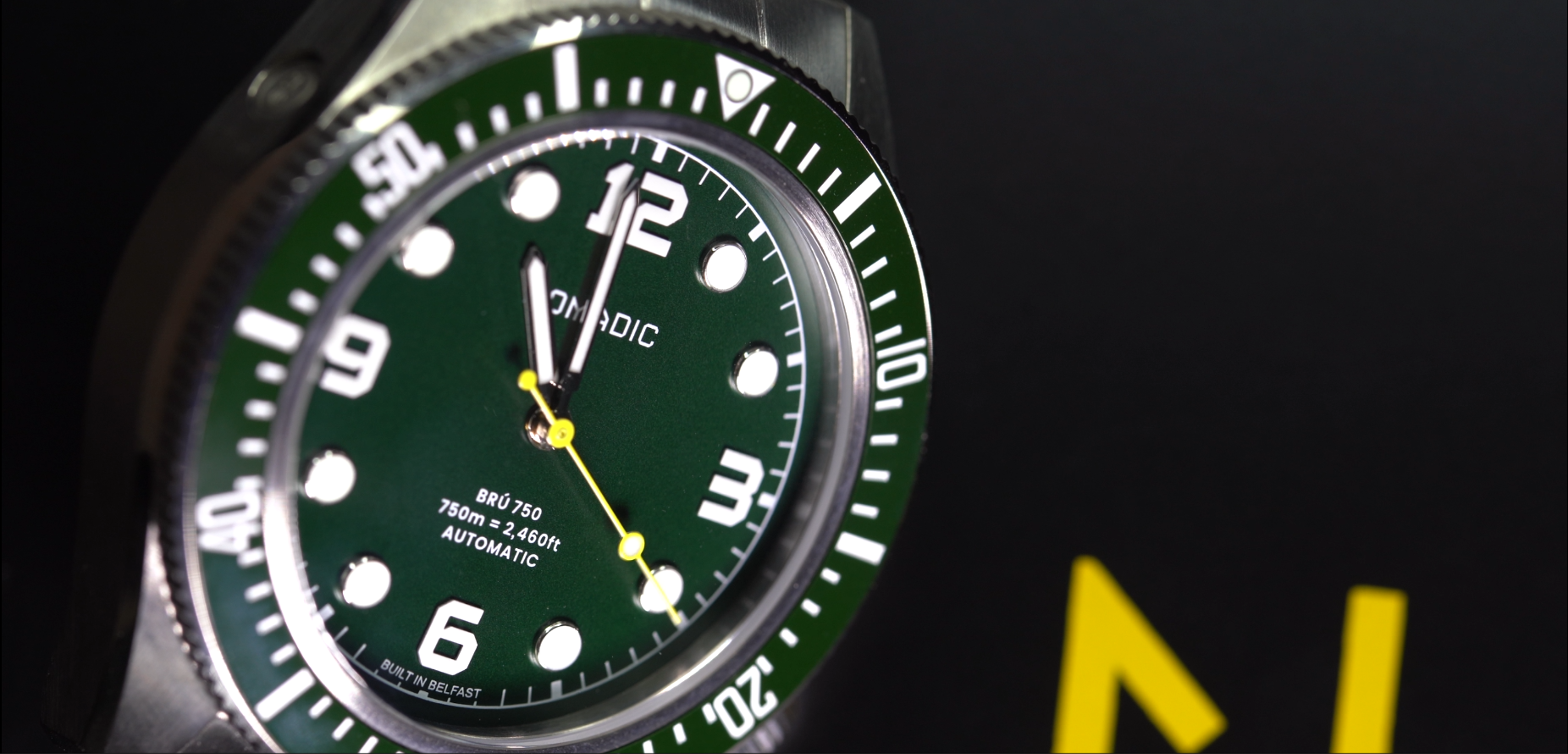
Visually, the BRU 750 wears a dark green dial that can shift towards near-black depending on lighting. It leans into a modern interpretation of British racing green, understated, slightly muted, and not overly flashy.
However, it is also a bit of a dust magnet, with particles showing more clearly than expected on the dial surface.
One of the more divisive design choices is the Arabic numeral font. While functional, it feels slightly at odds with the otherwise modern execution of the watch. The bezel typography, meanwhile, leans more vintage-inspired, similar to what you might see on watches like the Traska Freediver.
That contrast creates a tension: is this a contemporary technical diver, or a modern watch borrowing heritage cues?
Nomadic seems to want both.
Wearability: Titanium Lightness vs Visual Bulk
On paper, 13.5mm thickness is reasonable for a watch with this depth rating. On the wrist, however, it wears a little chunkier than the numbers suggest.
This comes down to case architecture: the flat sapphire and bezel alignment create a stacked visual profile, making it feel taller than it actually is.
That said, titanium construction keeps the weight down significantly, which helps balance out the perceived bulk. It’s still a comfortable wear, just not a slim one.
The 4 o’clock crown position (a nod to Seiko design philosophy), integrated crown guards, and concealed helium escape valve all reinforce its tool-watch intent.
Context: Where Does 750 Metres Even Fit?
The obvious comparison is the Doxa Sub 750T, a rare 750m-rated diver priced higher at around £2,500. Above that sits watches like the Tudor Pelagos Ultra, rated to extreme depths and positioned firmly in professional dive territory.
In reality, very few buyers will ever need 750 metres of water resistance. Even the Omega Seamaster Planet Ocean or Rolex Sea-Dweller, both engineered for extreme conditions, exist more as engineering statements than practical necessities.
Which raises the key question: what is this watch actually selling?
The Nomadic Proposition: Specs Over Story
Nomadic Watches represents a growing class of microbrands: ambitious, specification-driven, and trying to challenge Swiss incumbents on value rather than heritage.
Their wider range includes GADA-style watches, GMTs, chronographs, and integrated bracelet designs, a fairly standard modern microbrand lineup.
But the BRU 750 is different. It feels like a statement piece: proof that Nomadic can produce something technically credible in the same conversation as established Swiss dive watches.
The problem is that watches are rarely bought on specification alone.
The Reality of the Dive Watch Market
The uncomfortable truth is that dive watches are not purchased because of depth ratings. If they were, the Rolex Sea-Dweller would outsell the Submariner.
Instead, buyers respond to narrative, identity, and cultural weight. The Submariner is not just a tool watch — it is an icon, reinforced over decades of mythmaking and cultural placement.
Without that layer of story, even an objectively superior specification sheet struggles to resonate at scale.
And this is where the BRU 750 faces its biggest challenge: at £1,950, buyers expect not just capability, but meaning.
The Trade-Off: Engineering vs Emotion
From a purely rational standpoint, the BRU 750 is compelling:
- Higher water resistance than many Swiss competitors
- Titanium construction throughout
- Strong component selection
- Competitive pricing versus specification
But emotionally, it lacks the gravitational pull of established icons. It doesn’t yet have the mythology that turns a watch into something people aspire to own, rather than simply evaluate.
That doesn’t make it great — it just places it in a more difficult category to succeed in.
Final Thoughts
The Nomadic BRU 750 is best understood as a “statement of capability” from a young brand. It demonstrates technical seriousness and delivers an impressive spec sheet at its price point.
But it also highlights a broader truth about the watch industry: specifications alone rarely win.
A watch like this will appeal strongly to enthusiasts who prioritise engineering value. For everyone else, the decision will likely come down to something less measurable — story, emotion, and identity.
And that leaves us with the final question the watch itself raises:
Do you actually need a 750 metre dive watch?
No.
But then again, watches were never really about need.

Leave a Reply