
On this channel, I have a few rules about the watches I feature. They have to be interesting. Interesting to me, interesting to you—or simply just good watches. I’m not in the business of unnecessary takedowns. There’s already more than enough negativity in the watch world.
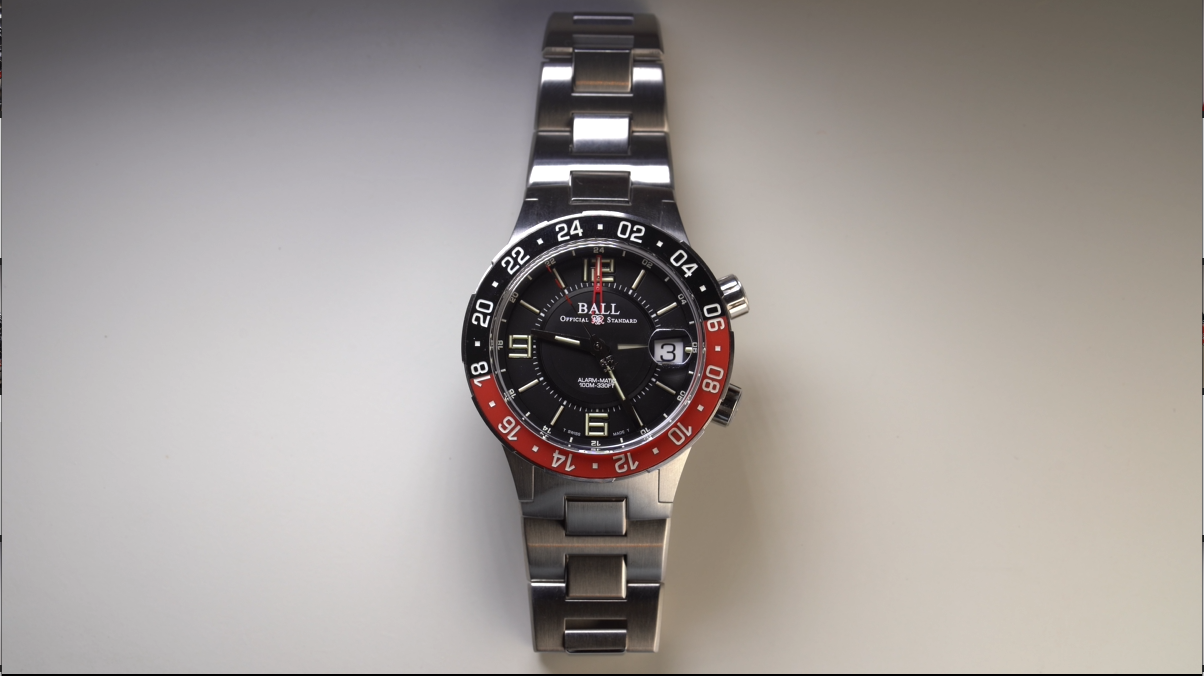
The Ball Roadmaster M Model A isn’t entirely to my personal taste. And given that it’s limited to just 333 pieces, I doubt many of you are actively considering one. This isn’t going to be a long-term view magnet like a Seiko or Citizen.
But none of that makes it a bad watch. Nor does it mean it shouldn’t be documented. It absolutely fulfills that first criterion: it’s interesting. And more than that, it highlights one of the biggest challenges facing modern watchmaking.
A Watch That Defies the Trend
While much of the industry drifts back toward restrained, sub-40mm cases, this watch stands in defiance.
- 41mm wide
- 48.5mm lug-to-lug
- 15.2mm thick
For context, that’s a full millimetre thicker than my Tudor Black Bay GMT—and you feel every bit of it.
It has that familiar “Seiko effect”: a squared-off bezel and relatively flat architecture with fewer visual layers to disguise the height. There’s nowhere for those 15.2 millimetres to hide.
So why is it so thick?
Because there’s a lot going on.
A GMT… and Then Some
The red-and-black “Coke” bezel signals one complication immediately: this is a GMT. That explains some of the thickness.
But not all of it.
At four o’clock sits a second crown. And what does it control?
An alarm.
And I’ll admit—that’s genuinely fun. A redeeming feature. There’s something charming about a mechanical alarm in a modern sports watch.
In fact, the alarm chime evokes a faint sense of old-world railroad romance—the very heritage Ball trades upon.
The Railroad Legacy
Beneath the Ball name—printed both on the crystal and visible on the rotor—you’ll see the phrase “Official Standard.”
That’s not marketing fluff pulled from thin air.
After the Great Kipton Train Wreck of 1891, caused in part by a conductor’s stopped watch, Webb C. Ball was appointed Chief Time Inspector. He established strict timekeeping standards for railroad watches—and eventually launched his own brand.
If you want something done properly, do it yourself.
That spirit remains here. Large hour indices, a prominent date under a cyclops lens, a GMT complication, an alarm, and Ball’s signature tritium gas tubes illuminating the dial—all powered by the in-house Ball RRM7379 calibre, regulated to -4/+6 seconds per day.
If your goal is to tell the time—across time zones, in the dark, with precision—this watch will oblige in several different ways.
And yet…
Innovation Doesn’t Guarantee Sales
Ball’s PR team reached out to me about this model. Initial reviews surfaced in 2024. Nearly two years later, they still haven’t sold all 333 pieces.
Despite the new movement.
Despite the innovation.
Despite the heritage.
At $6,599 (around £5,300), this is serious money.
Yes, it offers unique elements:
- A dual-crown layout
- Mechanical alarm
- Tritium gas tube illumination
- An integrated-esque bracelet reminiscent of an Oyster design
But there’s an elephant in the room.
It looks like a Rolex GMT-Master.
Maybe less so without the cyclops—but it has one. So even with its technical merits, even if you could argue it’s functionally superior in some ways, it feels like an homage piece.
Even the name—“Roadmaster”—echoes that familiar territory.
The Price Problem
If this were priced alongside Christopher Ward-level tool watches, perhaps it would be a different story. It might be a cult favourite. A hype sleeper hit.
But it isn’t.
At this level, you’re shopping used Omega territory. You’re not impossibly far off a vintage GMT-Master II 16710 “Coke” or even a 16610 Submariner.
And that’s the real challenge.
This watch wasn’t designed to sell in huge numbers. If it were, it wouldn’t be limited to 333 pieces. Instead, it feels more like a technical showcase—a statement of capability. A way for Ball to demonstrate innovation, generate headlines, and remind the market what it can do.
And perhaps, as a result, sell a few more Trainmasters, Engineers, and Firemans along the way.
The AURA Score
If you’ve been around the channel before, you’ll know my AURA system—a semi-objective, semi-holistic way of ranking watches.
- Aestheticism – 5
- Utility (value for money, maximum output for minimum input) – 5
- Romanticism – 5
- Authenticity – 5
That gives us 20 out of 40.
An average watch.
But an interesting one.
And sometimes, in a world of safe releases and incremental upgrades, interesting might just be enough.

Leave a Reply