
I do not usually do reviews. At least not in the traditional sense. But every now and then a watch comes along that enough people ask about, and enough people are clearly considering buying, that it feels worth sitting down and giving it proper thought. The Traska Freediver is one of those watches.
It is often described as exactly what watch people claim to want. An affordable, go anywhere, do anything dive watch with solid build quality. The kind of watch that quietly exposes just how overpriced and overhyped a lot of luxury Swiss sports watches really are.
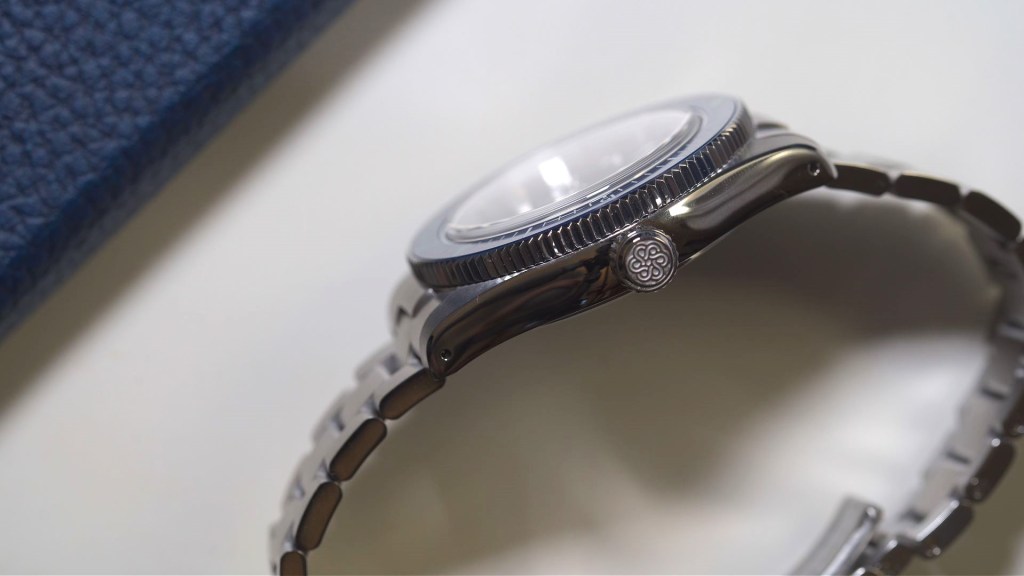
This is the seventh generation of the Traska Freediver, and on paper it ticks almost every box. You get 200 metres of water resistance, a Miyota 9039 automatic movement, and a 40.5mm stainless steel case with a 48mm lug to lug measurement. Lug width is a sensible 20mm, and the bracelet tapers nicely down to 16mm at the clasp.
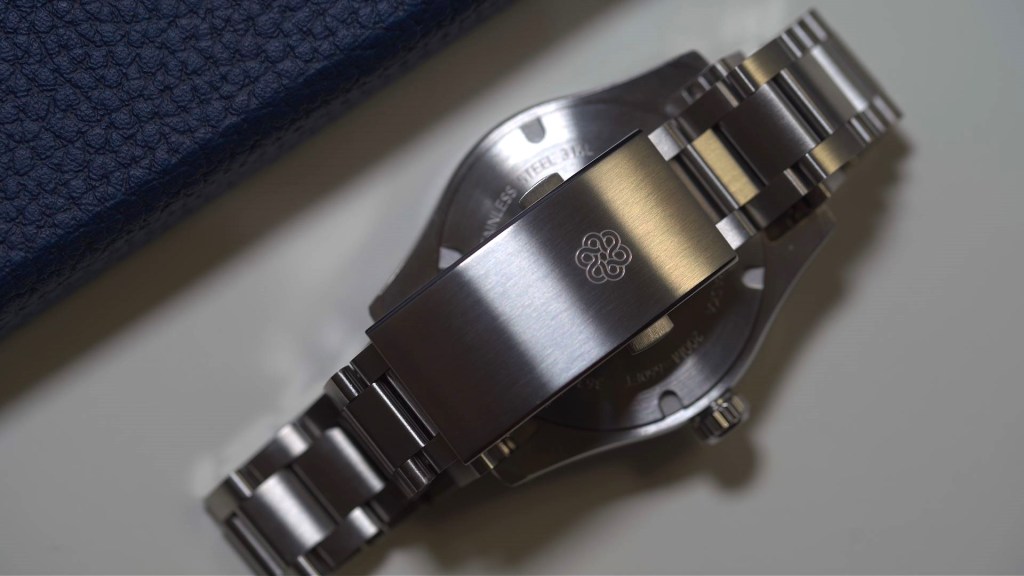
The bracelet also features on the fly adjustment, which is excellent in theory and in practice. I did find myself adjusting it throughout the day to get it just right, until I realised I was starting to look slightly unhinged constantly taking my watch off and putting it back on again.
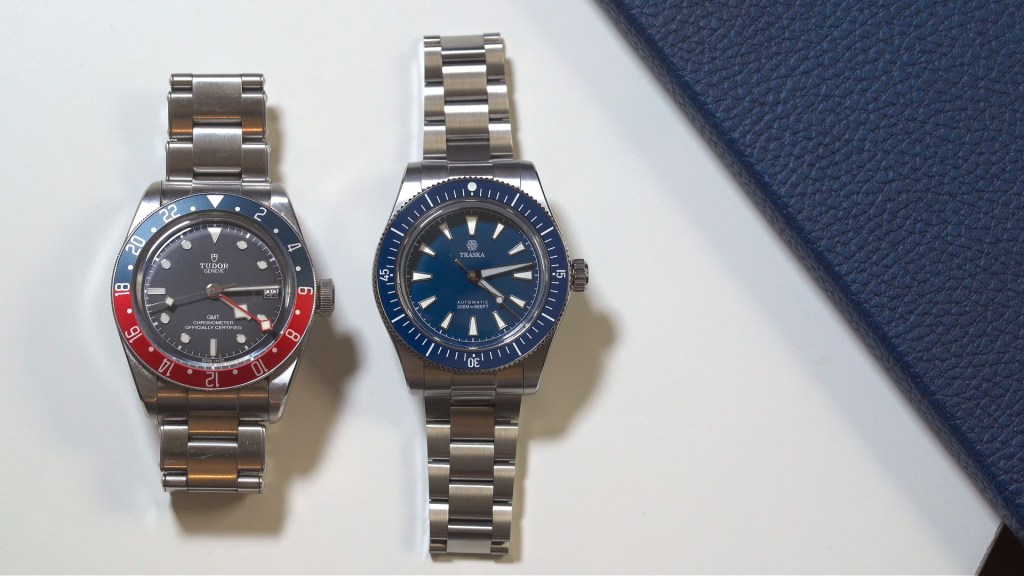
Thickness is listed at 10.5mm to the bezel and 11.9mm including the boxed domed sapphire. On paper that sounds very reasonable, but in reality the watch wears a little larger than the numbers suggest. The bezel sits quite high and has a squared off profile, which gives the watch more visual presence. In overall feel it is not a million miles away from my Tudor Black Bay GMT. Shape matters just as much as raw dimensions, something spec sheet obsessives often forget.
There are downsides. Like most Miyota powered watches, the rotor is on the loud side. You notice it, especially at first. Some people will care more than others, but it is worth mentioning.
Beyond that, the quality is genuinely impressive. It feels better than a typical Seiko, and probably comparable to some Prospex models. It does not quite reach Tudor or higher end Longines territory, but it also costs a fraction of the price. When you frame it that way, expectations feel very well managed.
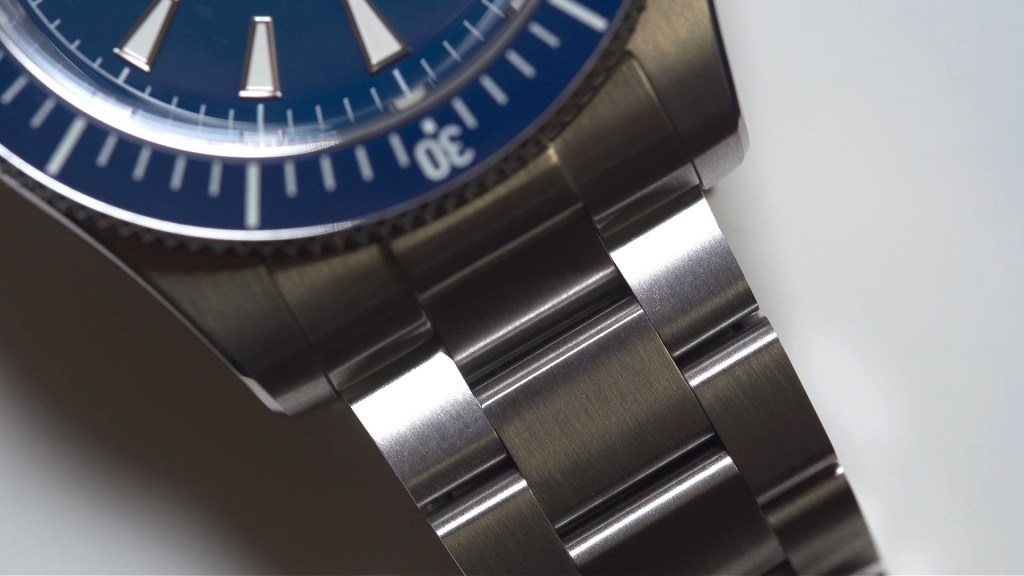
Put this up against watches like the Longines HydroConquest or the Oris Diver Sixty Five and it holds its own surprisingly well. That is not something you could say about most sub one thousand dollar dive watches. Traska have done a good job here.
The more important question, though, is how it feels in real life. Does it look good when you are actually wearing it day to day? The answer is yes. Does it still look good when you are chopping vegetables for dinner? Also yes. And does it give you that slightly romantic, Steve McQueen lurking around the paddock at Le Mans feeling? Somehow, yes again.
If you are in the market for a retro styled blue dive watch under a thousand dollars, it is very hard to argue against this. And if you are already considering it, you probably know that.
Will I regret sending this loaner back? No, and that is only because I already own watches that fill this role in my collection. But put this on a blue rubber strap, or even a denim strap, and the conversation becomes a little more interesting.
Which brings us to the bigger question. Why is this watch important?
The Traska Freediver sits at the intersection of two categories that matter a great deal in watchmaking. The blue dive watch, and the retro styled watch.
The blue dive watch is its own category entirely, even if we do not always acknowledge it. Almost every brand offers one, and very few buyers actively debate between black and blue. Navy blue is a safe choice, but also a quietly confident one. It works with most wardrobes, especially the very male tendency toward more navy. It is understated, versatile, and familiar.
This Traska joins a lineage that includes watches like the Omega Seamaster 300M, the Tudor Black Bay Fifty Eight Blue, and the Glashütte SeaQ. All of these are now considered icons.
They are iconic largely because they have been around long enough to become retro. Their designs have been seen by multiple generations, building trust, familiarity, and a sense of continuity. That continuity is the heritage you are really buying when you purchase a luxury Swiss watch. It is also why brands are so keen to tell you the year they were founded.
Traska does not have that timeline behind it. And yet when you wear the Freediver, you are still wearing that broader legacy of dive watches. It deliberately avoids the modern, almost industrial aesthetic of watches like the Tag Heuer Aquaracer, the Oris Aquis, or the Tudor Pelagos. Instead, it leans into the softer, vintage inspired design language we associate with Black Bays and SeaQs.
Crucially, it does this while retaining modern build quality, a modern and well supported movement, and a warranty. The bezel action may not be quite as satisfyingly crisp as a Tudor, but in reality this is all the blue retro dive watch most people will ever need.
Which leads to the uncomfortable question. How much are we prepared to pay for heritage?
This watch is not as refined as a modern Tudor. The bracelet is not as supple, and the finishing is not as luxurious. But over the course of a normal day, is it thousands of pounds less comfortable or enjoyable to wear? Probably not.
So what makes up the rest of the price difference? Is it history, branding, or simply the feeling of saying you own a Swiss watch from a certain name?
That is a personal decision. It is your money, after all.
This is exactly where microbrands like Traska fit in. By removing the overheads of celebrity ambassadors, Formula One sponsorships, and in house movement development, the price drops dramatically. And yet, despite years of microbrands undercutting traditional players, the mainstream luxury market remains strong.
That tells us something. Heritage still matters. Just perhaps not in the way we think.
There are two concepts at play here. Nostalgia, which most people understand, and anemoia, which is nostalgia for a time you never experienced.
If you grew up in the seventies or eighties, your nostalgic watch might be a Rolex Explorer you remember seeing in a magazine. But if you were not there, what you are really buying into is the feeling of that era. The idea of it.
Dive watches transport us back to a time when people appeared to be doing things with their watches. Exploring oceans, discovering wrecks, going places. Not sitting at desks running spreadsheets.
Watches like the Traska Freediver tap into that feeling. If your heart is set on a blue Rolex Submariner because that specific watch means something to you, this will not replace it. But if you are drawn to vintage styled watches as a window into a past you never lived, then this fits neatly into that space.
There is nothing wrong with this watch. It is just not a Rolex. And for many people, that will be absolutely fine.


Leave a comment