
The planet is ending. Or, more accurately, it’s changing into a state where it will be just fine, just not for us.
Climate change remains a controversial topic, but even among those who deny it, something has shifted. People are beginning to notice that the weather doesn’t behave as it used to. Summers are stranger. Winters are softer. Extremes are more frequent. Denial is harder when lived experience starts to contradict belief.
And in my hands is a watch made of rubbish. Discarded apple waste, recycled steel, and good intentions. It won’t stop the end of the world—but it might, at the very least, help us talk about it.
If you want to check out Detrash – do so by clicking this link – it’s an affiliate link *hey ho
Modern Business Is Fragile, Wasteful, and Unsustainable
Behind me sits a small bookshelf of “next up” reads. Some books stay for years. Others move quickly. Some skip the queue entirely because if you think I’m bad for buying watches, you’ve not seen me in a bookshop.
One book I’ve owned for years but only recently returned to is The Last Oil Shock by David Strahan. This isn’t a hand-wringing environmentalist manifesto. It’s an investigation into oil production, geopolitics, and what happens when a resource-driven world reaches its peak. Strahan links oil decline to global instability, including conflicts like the Iraq War, and argues that modern civilisation is built on an energy model that is inherently fragile.
Even if you deny climate change outright, the book makes something painfully clear: modern business is unstable, volatile, and spectacularly wasteful.
And the watch industry is no exception.
Rolex has its “Perpetual Planet” initiative, yet ships watches around the globe in large wooden boxes. Omega has similar sustainability messaging. Oris made those… unfortunate Aquis experiments. Much of it feels like greenwashing.
The reality is this: parts are shipped from Asia to Switzerland by container ships burning filthy bunker fuel, or by air. Finished watches are then shipped globally, again in oversized packaging. Whether you’re an environmentalist or not, this is an inefficient, bloated system.
That isn’t a “woke” argument, it’s a logistical one. And if it annoys a few people enough to comment, at least they’re part of the conversation.
The Detrash Watch: A Conversation Starter Disguised as a Watch
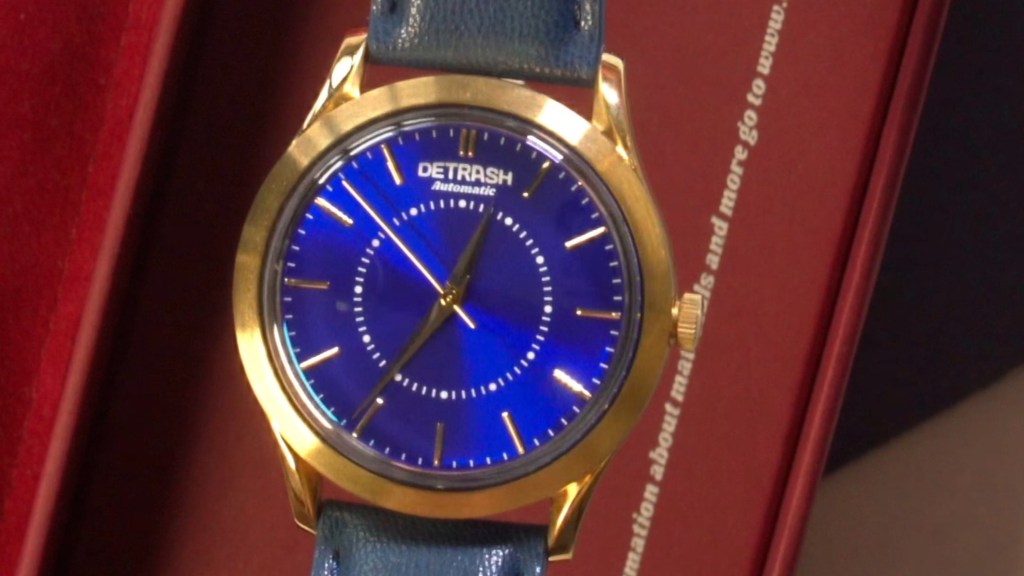
This is where the Detrash Ocean Blue comes in.
Strictly speaking, it is a watch. It tells the time accurately thanks to a Miyota 9039 movement. It has hour, minute, and seconds hands. Sapphire crystal. Display caseback.
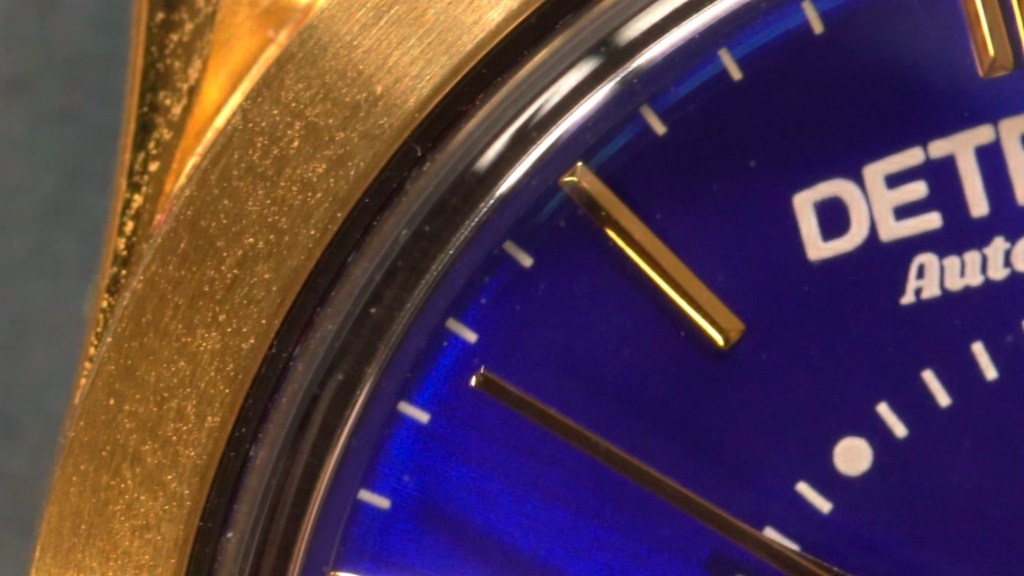
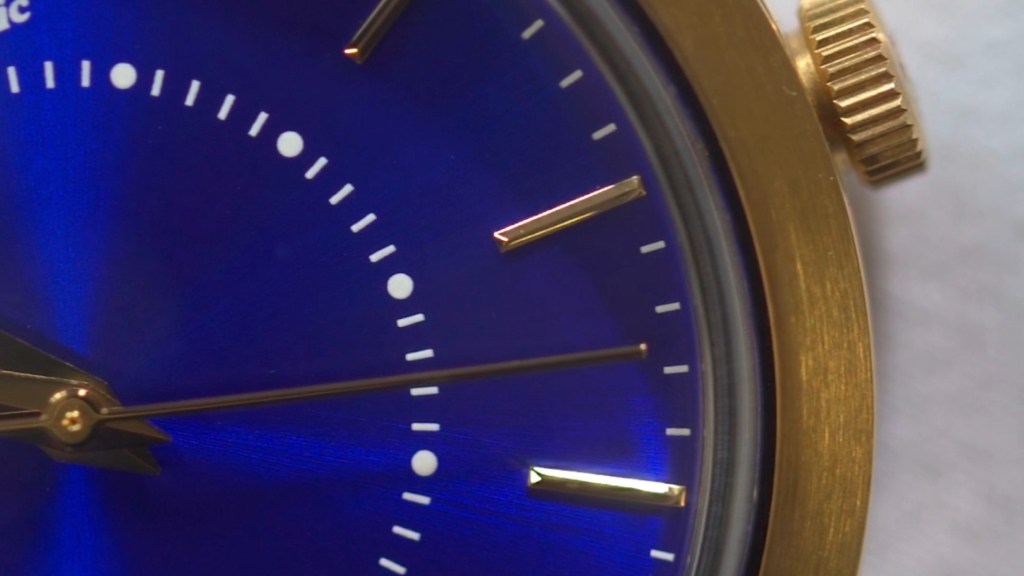
It even borrows design cues from proper watchmaking heritage: a dial inspired by the JLC Memovox worn by Steve McQueen in The Thomas Crown Affair, twisted lugs reminiscent of a Universal Genève Polerouter, and a gold PVD case. The name “Aucean Blue” is spelled like the chemical formula for gold—Au—because of course it is. We appreciate a pun at Doug’s Watches.
And honestly? It’s a sexy watch.
I rotate watches constantly—between my own collection and press pieces—but the first day I wore this, people noticed. Not watch people. Normal people. Not polite interest, but genuine curiosity: What is that? That looks cool. I’d wear that.
When I told them the strap was made from apple waste from the juice industry, they found it odd, but intriguing. When I explained the case was 80% recycled steel, they became more interested, not less.
We’ve all had the opposite experience. Someone asks about your watch, and five minutes later they regret it as you explain perlage and anglage like a hostage negotiator. This watch holds attention longer. It lets you quietly signal environmental concern while undermining the assumption that sustainable products are always inferior.
We’ve eaten Quorn, it wasn’t right. We’ve tried oat milk, why does liquid have texture? We’ve considered electric cars and then panicked about range.
But this? It doesn’t smell weird. It looks good (subjectively, obviously). And at £445, it feels appropriately premium.
Not a Collector’s Watch and That’s the Point
I wore this to a RedBar event. Some collectors enjoyed the novelty. Others, those with very expensive tastes, were indifferent.
That’s fine. This isn’t a watch for watch collectors.
It’s a watch for the mass market. Because if your goal is to normalise sustainable materials and fund environmental causes through initiatives like 1% for the Planet, you need scale. The harsh truth is that watch enthusiasts myself included are a tiny, insular group. Passionate, yes. Influential? Not really.
Real change comes when the mass market starts demanding sustainability as standard.
This watch won’t save the planet. I weighed it at 60 grams total. Roughly half of that is a standard Miyota movement with no recycling involved. Thirty grams of recycled steel isn’t cleaning up the oceans. On its own, it’s borderline gimmicky.
But that’s missing the point.
The value lies in proof of concept. If recycled materials can work in a watch, they can work in phones, cars, televisions. The real impact is perceptual, not material.
There’s also value in commitment and accountability.
While working on a broader project about microbrands, I interviewed Guy, the founder of Detrash. He spoke about “conscious capitalism” the idea that businesses should treat the planet, workers, and society as stakeholders, not just shareholders.
I like this idea. I’ve read plenty of left-wing economic theory. There’s a bust of Karl Marx in my living room (semi-ironically). But I also like shiny things. Capitalism can be great!
I’d just like the planet to remain habitable. I’m 25. Without it, there is no market.
Watches as Identity Signals
Watches are one of the only forms of jewellery men can wear across almost all social strata. As a result, they’re powerful tools for self-expression.
A Rolex Daytona and an Omega Speedmaster are mechanically similar, but socially worlds apart.
The Daytona says: I’ve made it.
The Speedmaster says: I appreciate achievement.
The Detrash says: I care about the planet.
And perhaps more importantly, it might encourage you to continue making environmentally sound decisions, if only to live up to the image you’ve chosen to project.
Some viewers won’t like this. That’s fine. Disagreement is healthy. But the world is changing, tastes are changing, and younger generations don’t necessarily want to look like Gordon Gekko. They don’t yearn for gold Daytonas. They want understated, thoughtful design, maybe that’s why Cartier is resurging.
Detrash exists for that shift. It may not be for you. You can still buy the Rolex. But maybe, in a few years, enough people will demand that it’s made from reused metals.
The Aura System Verdict
Using my semi-objective Aura system:
Aestheticism:
10/10. Not just for looks, but for its ability to spark conversation.
Utility:
8/10. A solid Miyota 9039, well-finished case, unique twisted lugs, and a genuinely pleasant strap.
Romanticism:
5/10. I enjoy wearing it, but there’s a twinge of guilt—hard to ignore when you daily-drive a 3-litre BMW.
Authenticity:
6/10. Honest marketing, clear materials. Full marks will come when recycled movements become viable.
Total: 29.
Pretty good.
If you want to check out Detrash – do so by clicking this link – it’s an affiliate link *hey ho


Leave a comment